IB vs. Common Core: What's the Difference — and Which Is Right for Your Child?
PSPauline Smith EdD · July 25, 2026 · 5 min read
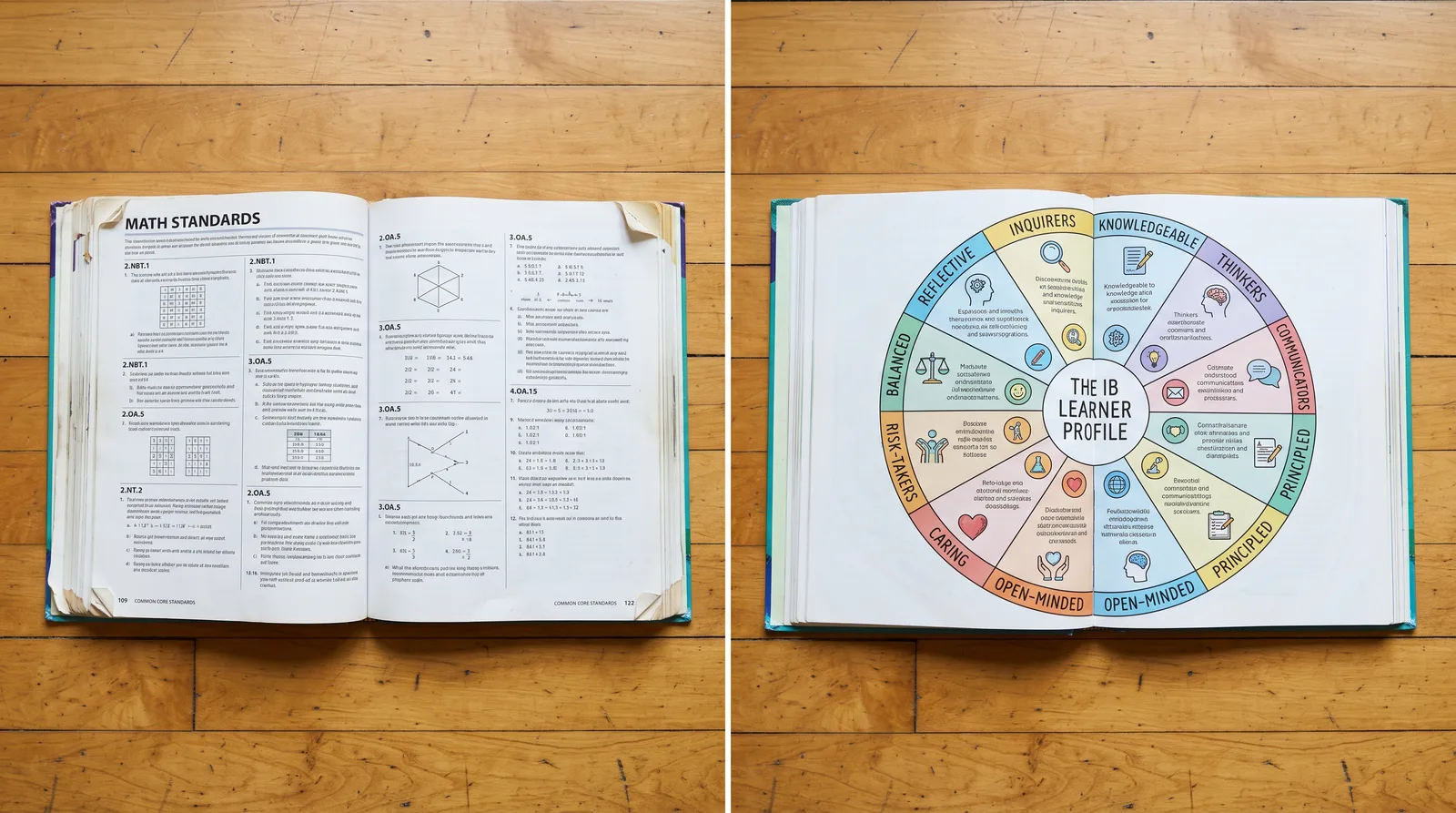
If you've spent any time researching schools for your child — virtual, traditional, or anywhere in between — you've almost certainly run into two phrases that get tossed around like they're interchangeable: IB (International Baccalaureate) and Common Core. They're not the same thing. Not even close. And confusing them can lead families to make school choices based on a misunderstanding of what their child is actually going to experience in the classroom.
Let me break this down plainly.
What Common Core Actually Is
Common Core is a set of academic standards — specific, grade-by-grade descriptions of what students should know and be able to do in English Language Arts and Mathematics by the end of each school year. It tells teachers what to teach. It does not dictate how to teach it, what curriculum to use, or what the classroom experience should feel like.
Think of Common Core as a floor. It defines the minimum level of skill a student should reach at each grade so that a child moving from Georgia to Oregon doesn't fall through the cracks. It's about consistency and equity across schools and states.
What Common Core does well:
- Sets clear, measurable literacy and math benchmarks
- Emphasizes reading complex texts and explaining reasoning in math, not just getting the right answer
- Creates a shared academic language across most U.S. schools
What it doesn't do:
- Define how deep students go beyond the standard
- Build inquiry, self-direction, or cross-disciplinary thinking into its structure
- Address the whole child — social-emotional development, creativity, or global perspective
What IB Actually Is
The International Baccalaureate is a philosophy and a framework for learning — not just a checklist of content. It was designed to develop thinkers, not just test-takers. IB programs (PYP for grades K–5, MYP for grades 6–10, and DP for grades 11–12) ask students to make connections across subjects, investigate big questions, reflect on their own learning, and engage with the world beyond their classroom walls.
IB is about how students learn, not just what they cover.
What IB does well:
- Builds the habits of an independent, reflective learner from an early age
- Pushes students to ask "why" and "so what," not just "what"
- Develops international-mindedness, empathy, and ethical reasoning
- Prepares students for the kind of open-ended, project-based work that college and careers actually demand
What it doesn't always make explicit:
- Specific grade-level content benchmarks the way Common Core does
- A standardized progression that's easy to measure on a traditional report card
Where They Overlap — and Why That Matters
Here's the thing most people miss: IB and Common Core are not opponents. A strong reader who can analyze complex text? That's both Common Core ELA and IB Approaches to Learning working toward the same outcome. A student who can explain their mathematical reasoning clearly and apply it to real-world problems? Again — both frameworks want that.
The overlap lives in the skills that matter most:
- Critical thinking over rote memorization
- Evidence-based writing and argument
- Conceptual understanding in math and science, not just procedural fluency
The difference is depth and reach. Common Core tells you where the floor is. IB invites students to find out how high the ceiling can go.
So Which Is Right for Your Child?
Here's my honest answer: for most children, the question isn't either/or — it's whether their school knows how to hold both at once.
A school that teaches only to Common Core standards will give your child grade-level competency. That's important. But it often leaves gifted, curious, or highly motivated learners under-challenged, and it doesn't build the self-directed learning skills they'll need in college or a 21st-century career.
A school that delivers IB rigor without anchoring to clear content standards can leave gaps — especially for students who are building foundational literacy and numeracy skills and need explicit, sequential instruction.
The schools that serve students best are the ones that use Common Core as the foundation and IB as the architecture — ensuring every child meets grade-level benchmarks while also being pushed to think more deeply, connect more broadly, and grow more completely as a learner.
That's exactly the design philosophy behind the programs I teach in. When you build a school where UDL, SEL, and IB inquiry sit on top of Common Core standards, you're not picking one over the other — you're refusing to settle for less than both.
A Quick Reference Before You Go
| Common Core | IB | |
|---|---|---|
| Type | Academic standards | Learning philosophy & framework |
| Covers | ELA and Math (K–12) | All subjects (K–12, multiple programs) |
| Focus | What students should know | How students learn and grow |
| Strengths | Consistency, equity, measurable benchmarks | Inquiry, depth, global perspective |
| Best paired with | A rigorous, inquiry-driven methodology | Clear content standards and benchmarks |
If you're evaluating a school — virtual or in-person — ask them directly: How do you use Common Core standards, and where does IB thinking show up in daily instruction? A school that can answer that question clearly and confidently is one worth a second look.
Want to dig deeper into how these frameworks show up across different grade levels or subject areas? I write about this regularly — subscribe below and I'll send the next one straight to you.

Want to go deeper than a blog post?
Brown Tech Global Academy Pre-K - 12th Grade by Brown Tech Academy Industry
A full-spectrum, accredited virtual school delivering credit-bearing Pre-K–12 courses that weave IB rigor, UDL inclusivity, SEL, TAG enrichment, MESA STEM pathways, and Odyssey of the Mind creativity into one college-, career-, and innovation-ready experience — for every kind of learner.
Start learning — $300/mo