Enterprise Risk Management vs. Project Risk Management: Why Confusing the Two Derails Executive Careers
PSPauline Smith EdD · September 7, 2026 · 5 min read
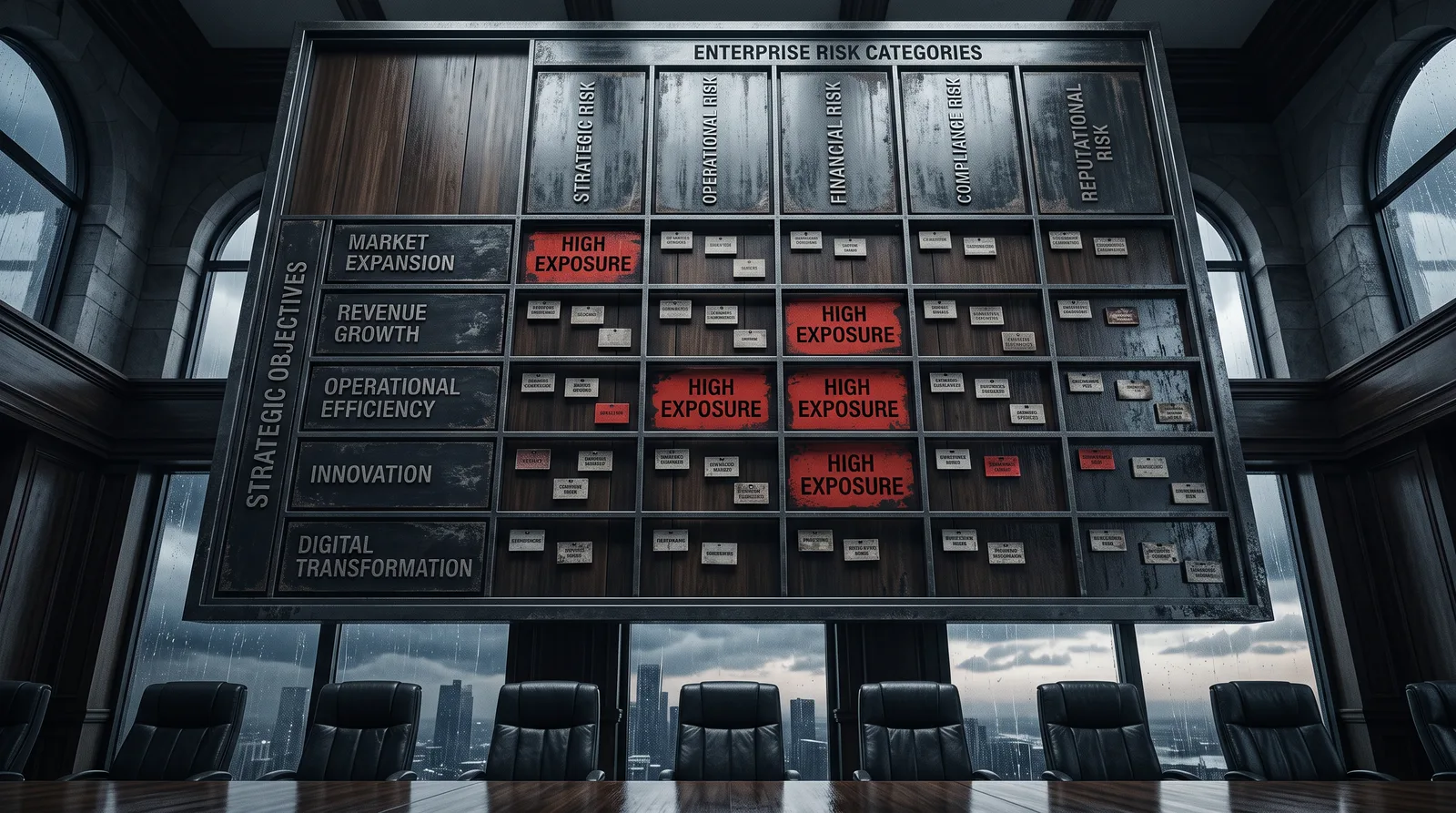
There is a moment many senior leaders never see coming. You have spent years delivering complex projects on time and under budget. You have built rock-solid risk registers, tracked red-amber-green dashboards with discipline, and escalated every issue before it became a crisis. Then you step into an executive role — and suddenly, the board is asking you questions your old toolkit cannot answer.
That is not a competence gap. That is a category gap. Enterprise risk management and project risk management are not the same discipline at different scales. They are fundamentally different in scope, governance authority, and strategic consequence. Conflating them is one of the most common — and career-limiting — mistakes I see senior professionals make.
Let me show you exactly where the line is.
What Project Risk Management Actually Is
Project risk management lives at the delivery level. Its core question is: What could prevent this initiative from hitting its scope, schedule, or budget targets?
The risks you manage here are bounded. A vendor delivers late. A key resource is reassigned. A technical dependency breaks. These are real problems, but they are problems that a project team can own, mitigate, and resolve largely within the initiative itself. The authority required is operational. The time horizon is the life of the project.
The tools — risk registers, probability-impact matrices, mitigation plans, issue logs — are designed for exactly this. They are excellent tools. They just do not travel up the organization.
What Enterprise Risk Management Actually Is
Enterprise risk management operates at the portfolio and organizational level. Its core question is entirely different: What systemic threats could prevent the organization from achieving its strategic objectives — and how does the board govern our exposure to them?
The risks here are not bounded by a single initiative. They are interconnected, often slow-moving, and sometimes invisible until they cascade. Think regulatory environment shifts that invalidate your market strategy. Think concentration risk in a supplier ecosystem that spans dozens of your active programs. Think reputational exposure that originates in one business unit and reaches the board agenda before any project manager knew there was a problem.
Enterprise risk is governed — not just managed. That distinction matters enormously. At the enterprise level, your job is not to solve the risk yourself. It is to architect the framework that ensures the right risks are surfaced to the right decision-makers with the right frequency, so the organization can make deliberate choices about what exposure it is willing to carry in pursuit of its strategy.
The Three Lines You Must Know
A governance concept that belongs in every executive's working vocabulary is the Three Lines Model, which clarifies who owns what in enterprise risk.
- First line: Operational management — the people running programs, functions, and business units who own risk day to day.
- Second line: Risk and compliance functions — the oversight layer that sets policy, monitors exposure, and reports to leadership.
- Third line: Internal audit — the independent assurance function that confirms the framework is working.
Here is where executives trip up: they confuse first-line execution with second-line governance. They insert themselves into the risk register instead of asking whether the risk framework itself is fit for purpose at the portfolio level. That is a category error — and boards notice it.
What Governance Authority Looks Like in Practice
At the enterprise level, your governance authority over risk includes several responsibilities that have no equivalent in project management.
Risk appetite setting. The board and executive leadership define how much uncertainty the organization will accept in pursuit of strategic goals — not per project, but as an organizational posture. You have to be able to articulate and defend that posture.
Portfolio-level risk aggregation. Individual projects may each carry acceptable risk. But if fifteen projects are all dependent on the same third-party platform, the aggregated exposure is a different animal entirely. Seeing that pattern — and acting on it — is an executive function.
Strategic risk reporting. When you brief the board on risk, you are not reading a project status report. You are presenting an interpreted view of enterprise exposure — what it means for the organization's strategic trajectory and what governance decisions the board needs to make. That requires a different analytical lens and a different communication register.
Risk-adjusted resource allocation. Enterprise leaders use risk intelligence to make capital and capacity decisions across the portfolio. That means moving resources toward initiatives that carry strategic upside and away from those that carry disproportionate organizational exposure — regardless of how well any individual project is performing.
Why This Confusion Stalls Executive Careers
When a senior leader manages enterprise risk like an elaborate project risk register, they tend to produce very detailed reports that answer questions no one at the board level was asking — and leave unanswered the governance questions that actually matter. Over time, the board stops treating them as a strategic thought partner and starts treating them as a sophisticated administrator.
That is not a reputation that is easy to reverse.
The shift that changes everything is learning to govern risk rather than just track it — to ask structural questions about framework, accountability, and organizational exposure rather than operational questions about individual issues and mitigation tasks.
Where to Go from Here
If you recognize yourself somewhere in this post — if you have ever walked into a board conversation with a project manager's toolkit and wondered why it felt insufficient — that awareness is the starting point. The next step is building the governance vocabulary, the framework design skills, and the board-level communication discipline that enterprise risk actually demands.
That is exactly the work we do in my practicum programs, particularly in Enterprise Program Mastery and Executive Governance Mastery. Both are built for senior leaders who are ready to stop managing at the task level and start governing at the portfolio level.
The distinction between these two disciplines is not academic. It is the line between a leader who executes and a leader who governs. And in a boardroom, those are not the same seat at the table.

Want to go deeper than a blog post?
Enterprise Program Mastery by Brown Tech Academy Industry
A rigorous executive practicum that takes senior program leaders through portfolio governance, strategic execution, and enterprise risk mastery — culminating in a board-ready portfolio defense. Built for professionals pursuing the Brown Tech Global Executive Certification standard.
Start learning — $197/mo